
binary number
In mathematics and digital electronics, a binary number is a number expressed in the binary numeral system or base-2 numeral system which represents numeric values using two different symbols: typically 0 (zero) and 1 (one). The base-2 system is a positional notation with a radix of 2.
what is a binary system in computer
Computers use binary - the digits 0 and 1 - to store data. A binary digit, or bit, is the smallest unit of data in computing. It is represented by a 0 or a 1. Binary numbers are made up of binary digits (bits), eg the binary number 1001.

what is a defination of binary system
binary number system. A method of representing numbers that has 2 as its base and uses only the digits 0 and 1. Each successive digit represents a power of 2. For example, 10011 represents (1 × 24) + (0 × 23) + (0 × 22) + (1 × 21) + (1 × 20), or 16 + 0 + 0 + 2 + 1, or 19. The American Heritage® Science Dictionary
eg:
| 10011 represents (1 × 2 4) + (0 × 2 3) + (0 × 2 2) + (1 × 2 1) + (1 × 20), or 16 + 0 + 0 + 2 + 1, or 19.what is a defination of binary data |
Techopedia explains Binary Data
Binary data is considered the native data/language of a computer and it interacts with the lowest abstraction layer of its hardware. This type of data is produced whenever a process is performed on a computer. The application requesting the process sends instructions in a high-level language that is ultimately converted into binary data to be executed or sent to the processor. All processes, regardless of their type, are converted into binary form before execution.
Most binary data can only be read by a computer, not a human.
Decimal
Decimal is a term that describes the base-10 number system, probably the most commonly used number system. The decimal number system consists of ten single- digit numbers: 0, 1, 2, 3, 4, 5, 6, 7, 8, and 9. The number after 9 is 10. The number after 19 is 20 and so forth. Additional powers of 10 require the addition of another positional digit.
Here is the number "forty-five and six-tenths" written as a decimal number: The decimal point goes between Ones and Tenths.
Binary data is considered the native data/language of a computer and it interacts with the lowest abstraction layer of its hardware. This type of data is produced whenever a process is performed on a computer. The application requesting the process sends instructions in a high-level language that is ultimately converted into binary data to be executed or sent to the processor. All processes, regardless of their type, are converted into binary form before execution.
Most binary data can only be read by a computer, not a human.
Most binary data can only be read by a computer, not a human.
Decimal
Decimal is a term that describes the base-10 number system, probably the most commonly used number system. The decimal number system consists of ten single- digit numbers: 0, 1, 2, 3, 4, 5, 6, 7, 8, and 9. The number after 9 is 10. The number after 19 is 20 and so forth. Additional powers of 10 require the addition of another positional digit.
Here is the number "forty-five and six-tenths" written as a decimal number: The decimal point goes between Ones and Tenths.
First, let's have an example:
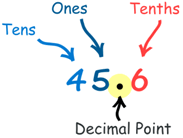 Here is the number "forty-five and six-tenths" written as a decimal number:
The decimal point goes between Ones and Tenths.
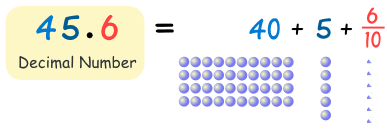
45.6 has 4 Tens, 5 Ones and 6 Tenths, like this:
convert decimal numbers to binary examples
Method 1 Short Division by Two with Remainder
- Set up the problem. For this example, let's convert the decimal number 15610 to binary. ...
- Divide. ...
- Continue to divide until you reach 0. ...
- Write out the new, binary number.
Here is the number "forty-five and six-tenths" written as a decimal number:
The decimal point goes between Ones and Tenths.
45.6 has 4 Tens, 5 Ones and 6 Tenths, like this:
convert decimal numbers to binary examples
Method 1 Short Division by Two with Remainder
- Set up the problem. For this example, let's convert the decimal number 15610 to binary. ...
- Divide. ...
- Continue to divide until you reach 0. ...
- Write out the new, binary number.

What are the difference between Binary and Decimal
| Decimal Numbers | Binary Numbers |
|---|---|
| Decimal numbers consist of combination ten digits or values from 0 to 9 (0,1,2,3,4,5,6,7,8,9). | Binary numbers are formed by combination of only 2 digits or values 0 (zero) and 1 (one). |
| The radix for decimal number is 10 i.e all the digits in a decimal number are expressed in terms of powers of 10. | The radix for binary number is 2 i.e all the digits or values in a binary number are expressed in terms of powers of 2. |
| Example of decimal number : 25 (Twenty Five) | Example of Binary number : 11001 (Twenty Five) |
Applications
| Applications
|

No comments:
Post a Comment